

Toxicity Warning Badge
GMD Systems of Bacharach, Inc., Pittsburgh, Pennsylvania manufactures and markets toxic gas detection and air sampling devices, with special emphasis on passive "badge" type dosimeters, worn by workers in potentially toxic environments to provide warning of exposure to hazardous chemicals.
For monitoring NASA and contractor personnel exposed to hydrazine and monomethyl hydrazine (MMH), NASA contracted with GMD Systems for development of a colorimetric gas monitoring dosimeter. Hydrazine and MMH are hyperbolic fuels that ignite on contact with an oxidizer; typical risk areas where exposure monitoring is required include facilities where the fuels are produced and facilities where workers are engaged in assembly and operational handling of spacecraft, missiles and aircraft auxiliary power units in which the fuels are used.
GMD Systems developed a reliable monitoring dosimeter for NASA, then modified the NASA technology to create a new commercial product, the GMD 530 Series Hydrazine Badge. The commercial version is used in chemical manufacturing, industrial cleaning applications and in areas where hydrazine is used as an oxygen scavenger, such as boiler feed water in the electric industry.
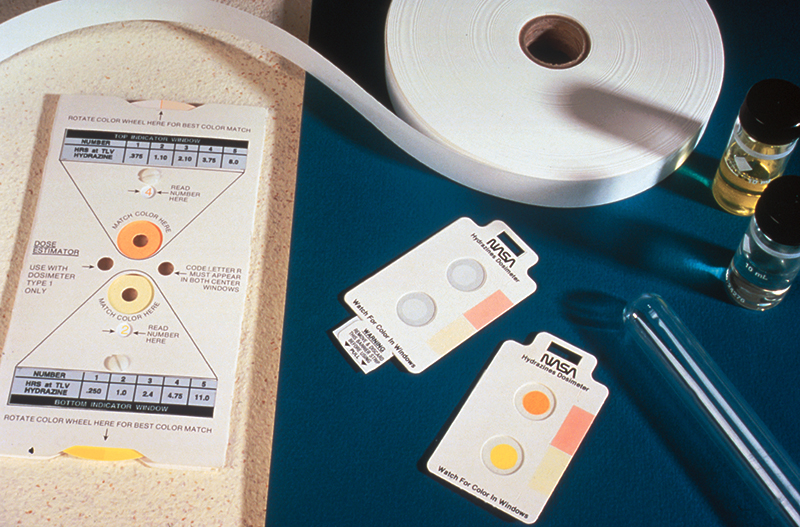
The 530 series badge has two separate paper tape chemistries in one badge; a pair of circular windows in the badge allow each tape to be exposed and observed. In the presence of either hydrazine or MMH, both tapes change colors, providing an immediate visual alarm.
In both cases, the density of the color stain increases in proportion of the hydrazine/MMH in the air and the total time of exposure. The system includes two types of pocket-size estimator cards (Dose Estimator Units), one for each substance. A supervisor uses the estimator to match the color of an exposed badge with a set of color standards for the particular substance involved; the standards are shown on the estimator card for quick reference. The color matching serves as a basis for immediate, accurate estimation of the level of exposure.
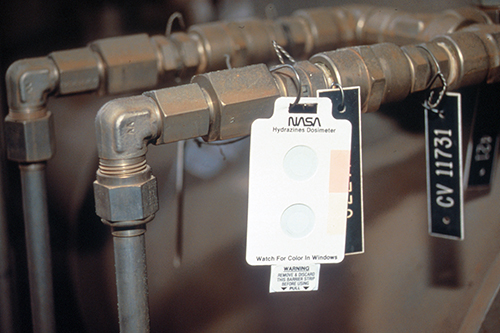
The badge offers secondary utility as a low-cost leak detector hung on suspect pipes or valves.
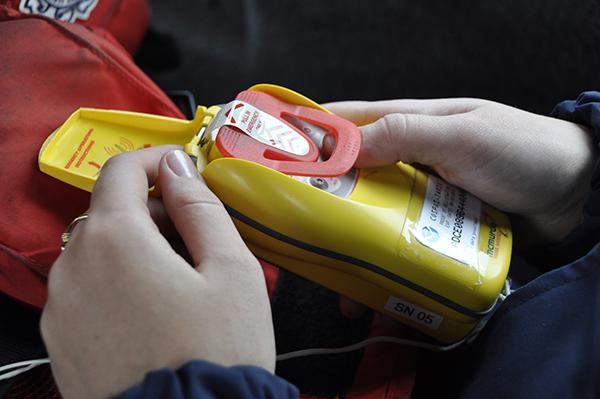
GMD Systems' Hydrazine Badge changes color when its wearer is exposed to a chemical containing a hydrazine component.