

Advanced Welding Torch
In the late 1970s, when the Space Shuttle was in early development, NASA recognized that the then-existing welding techniques were inadequate for the job of joining the huge aluminum segments of the Space Shuttle External Tank. Accordingly, Marshall Space Flight Center (MSFC) initiated development of Variable Polarity Plasma Arc (VPPA) welding. The VPPA concept dates to 1947, but it had never been fully developed; it employs a variable current waveform that enables the welding system to operate for preset time increments in either of two polarity modes for most effective joining of troublesome light alloys such as aluminum and magnesium.
In the course of VPPA development, it became apparent that the technique had broad potential for improving weld reliability and lowering costs not only in NASA work but in many private industry applications. Since there were no suitable commercially available tools for VPPA welding, MSFC expanded the development effort to include a technology transfer project designed to make VPPA available to the private sector.
A key part of this effort was development of a welding torch that would have dual utility, as a component of NASA's External Tank welding system and as a component of derivative systems for commercial applications. MSFC awarded the torch contract to B&B Precision Machine, Owens Cross Road, Alabama. Working in cooperation with MSFC's Materials and Processing Laboratory, B&B developed and patented a Shuttle-use torch that won a 1987 NASA Inventor of the Year Award for Bob Dempsey of B&B, Ernest Bayless and Sam Clark of MSFC.
MSFC and B&B continued development of VPPA. A major step in the late 1980s was a program to fully automate the system and eliminate the hand of the welder on the controls entirely. In 1989, a NASA decision to change the material of the External Tank triggered a new B&B development. The new alloy in some cases required "tack" welds prior to robotic seam welding; since tack welds are performed by hand, B&B was assigned development of a smaller version of the torch that would be easier to manipulate and would meet the needs of applications where access was limited. B&B delivered a prototype small torch in 1992.
The small torch, which has attracted considerable interest in the commercial sector, has the same features and advantages as the original torch, but it fits in approximately half the space. It is in commercial service with Whirlpool Corporation for sheet metal welding of major appliance parts, where the torch's production line dependability is a significant asset. Offering such advantages as multiple cost reductions and eventual reduction of requirements for x-ray inspection of welds, the microprocessor-controlled VPPA system is in use at the plants of such industrial giants as Babcock and Wilcox, Boeing, General Dynamics, Lockheed Martin and McDonnell Douglas. The system and the B&B torch continue to make all the welds in the External Tank and they have been selected as the preferred welding approach for the International Space Station.
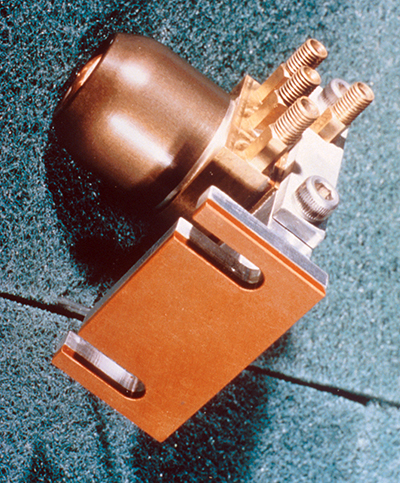
The B&B Precision Machine Variable Polarity Plasma Arc welding torch.
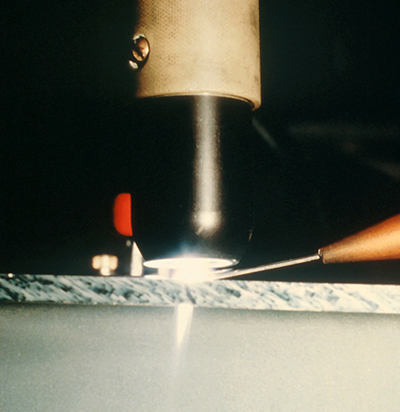
A small version of the B&B torch is used in commercial sheet metal welding.