


Lunar Gardening Tech Now Grows Ingredients for Health, Beauty Products
Subheadline
Cosmetics industry leaders turn to planting system designed for space
It started as a farming system for the Moon or Mars. Now it’s cultivating plant ingredients on Earth for cosmetics, nutritional supplements, and more.
The BioPod, a 37-foot-long, 16-foot-tall precision agriculture device, was developed by Interstellar Lab Inc. to hone the molecular composition of plants, isolating and enhancing particular nutrients or essences.
Interstellar sells the devices outright and also uses them to grow plants for companies.
“Recently we’ve been doing a lot of flowers for a contract with a large perfumer,” Interstellar CEO Barbara Belvisi said. “Our warehouse smells beautiful.”
‘If We’re Going to Live on Mars …’
Belvisi founded Interstellar in 2018, around the time she was working at NASA’s Ames Research Center in Silicon Valley, California, as a guest of the Space Portal team, an ad hoc group that aims to promote commercial space and collaborations.
Belvisi was researching how to integrate a bioregenerative life support system into a planetary space station.
“If we’re going to live on the Moon and if we’re going to live on Mars,” she thought, “how can we build a system that will produce the food we need and also recycle the water, produce the oxygen, and capture the CO2?”
Belvisi, who said her company would not exist without the support of NASA, designed a network of pods for the Moon and Mars, with drawings based on the space agency’s engineering and calculations for planetary greenhouses, and that plan became the basis for the Earth-based BioPod, Interstellar’s first spinoff.
Mutual Benefits
Dan Rasky and his colleagues at Ames who formed the Space Portal group some 20 years ago try to make NASA resources available to commercial endeavors that are aligned with the space agency’s goals.
“NASA benefits from the commercial activities, and the commercial activities benefit from NASA’s programmatic support,” he said, explaining the thinking that resulted in multiple successes, including the first commercial spacecraft cargo delivery to the International Space Station in 2012.
“Interstellar Lab actually plays right into that,” said Rasky, who worked with Belvisi through the Space Portal group. “She’s doing things that are obviously on a business side, on a commercial side, but they’re aligned with what NASA is trying to do, and it can clearly benefit NASA programs.”
Rasky introduced Belvisi to scientists and others at Ames to discuss NASA’s interests and requirements — exchanges that guided her own designs.
“We were impressed with the thoroughness of the work she was doing,” he said. “She had a solid technical and business foundation for what she was proposing to do.”
Extracting Molecules
Plants produce two types of molecules: primary metabolites, which the plant needs simply to be alive and grow, and secondary metabolites, which help it adapt to its environment.
Pharmaceuticals, cosmetics, and the food supplement industry extract these secondary metabolites for their specific properties and characteristics, such as vitamin C taken from acerola, a red, cherry-like fruit.
Plants may increase their production of secondary metabolites as a reaction to environmental factors like less water, more light, or changes in temperature or humidity.
“That’s what we do in our system,” Belvisi said. “We look first at what kind of climates will trigger the production of the specific molecule, and then we recreate those environments inside our system to accelerate the growth of the plant and to make sure it is producing the alcohol or vitamin or nutrient that we are targeting.”
Built with the constraints of space travel in mind, BioPods use 99% less water than traditional agriculture, eliminating waste and runoff, according to the company. They also collect and analyze data along the way.
Interstellar is currently using the device to grow plants for the cosmetics company L’Oréal, which aims by 2030 to bio-source nearly all of its ingredients from abundant minerals or circular processes.
Other customers include DSM, a large Dutch ingredient company that makes nutrition and beauty products; the Robertet Group, which develops raw materials and fragrances; and others.
Another Spinoff
Interstellar, with headquarters in the Paris suburb of Ivry-sur-Seine and a U.S. office in Merritt Island, Florida, went on to adapt the concept back to an actual in-space device it calls NuCLEUS, or Nutritional Closed-Loop Eco-Unit System, which is a series of cubes that can fit on a space station or other small, off-Earth environment.
“Each cube has a different climate,” Belvisi said, “so we can grow different types of species in controlled environments and really optimize the growth of the plants inside our system.”
Belvisi said NuCLEUS is powered by the same technology as the BioPod. “It’s a different form factor, but the same combination of hardware and artificial intelligence to autonomously recreate climates to grow plants,” she said.
Interstellar entered NuCLEUS in the Deep Space Food Challenge, which NASA held in collaboration with the Canadian Space Agency. The company won the grand prize of $750,000 in 2024.
Ralph Fritsche, a senior project manager for space crop production at NASA’s Kennedy Space Center in Florida, served as the head judge of the food challenge.
“Several things elevated the NuCLEUS concept above the others,” he said, noting that Interstellar’s offering leveraged the decomposing power of insects on inedible plant waste, which provides carbon dioxide that plants use as an input for photosynthesis.
“The components of NuCLEUS were designed for easy maintenance and repair,” he said. “The system also contains multiple individual growth chambers that provide not only system redundancy but flexibility for simultaneously growing a range of pick-and-eat salad crops, microgreens, mushrooms, and even insects.”
While Interstellar is in talks with NASA about further collaborations involving NuCLEUS, Belvisi said the company also has agreements with private space companies.
NuCLEUS also formed the basis of another spinoff called Pleiades, a smaller, modular farming system Interstellar uses to conduct research on more precise growing strategies for companies on Earth. Unlike the BioPod, which is designed to cultivate specialty plants at scale, the NuCLEUS-like system allows even more precise control over and monitoring of growing conditions.
Cameras and sensors enable researchers to watch plant reactions to the environment. “It’s kind of a thing at Interstellar to start with a space product and then move directly into Earth applications,” Belvisi said. “It’s something that you find in all our product lines.”
The BioPod, a 37-foot-long, 16-foot-tall precision agriculture device pictured here, was developed by Interstellar Lab to hone the molecular composition of plants, isolating and enhancing particular nutrients or essences. Credit: Interstellar Lab Inc.
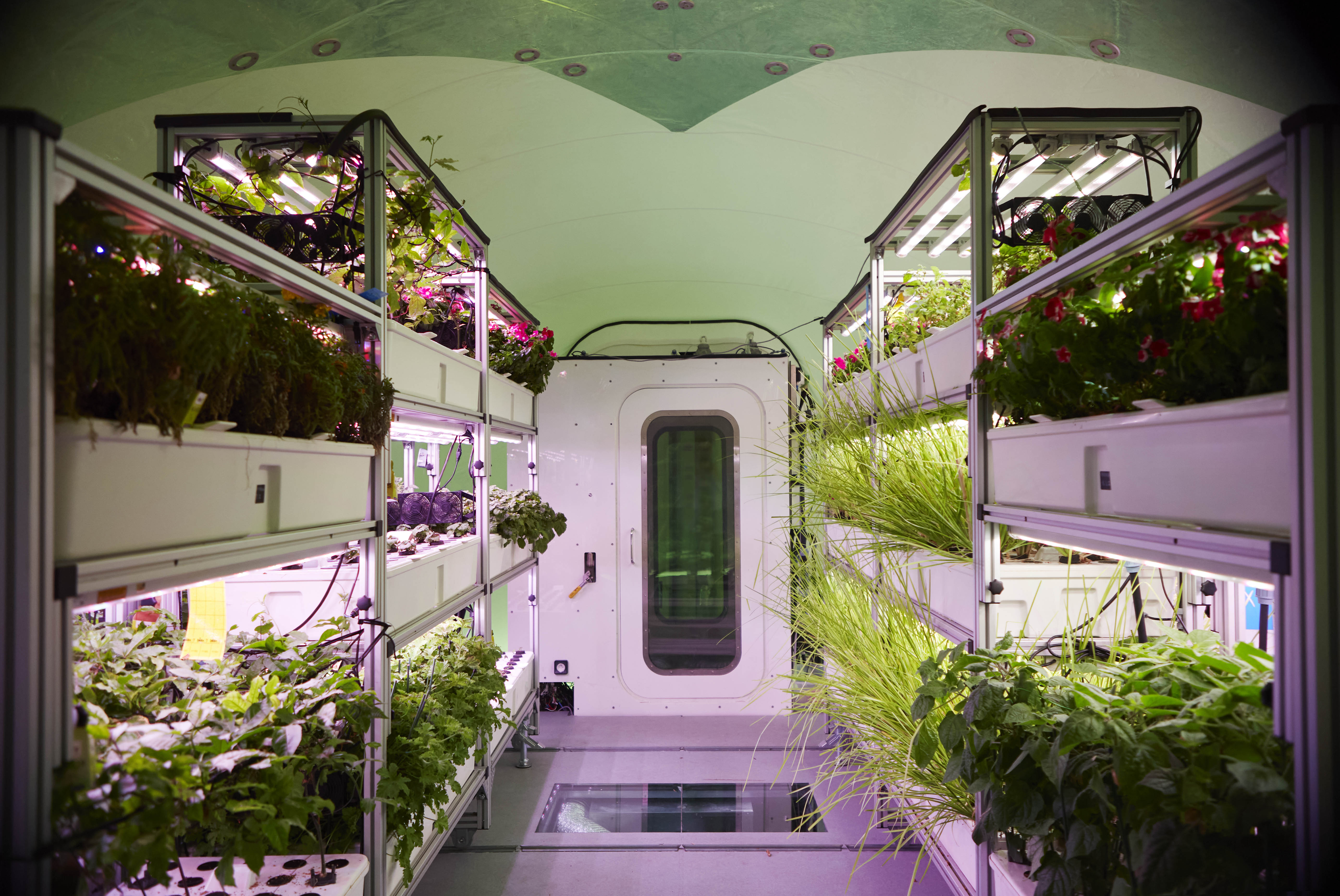
Interstellar Lab researches what climates will trigger production of a specific molecule and then recreates those conditions inside the BioPod to quickly produce the desired vitamin or nutrient. Credit: Interstellar Lab Inc.
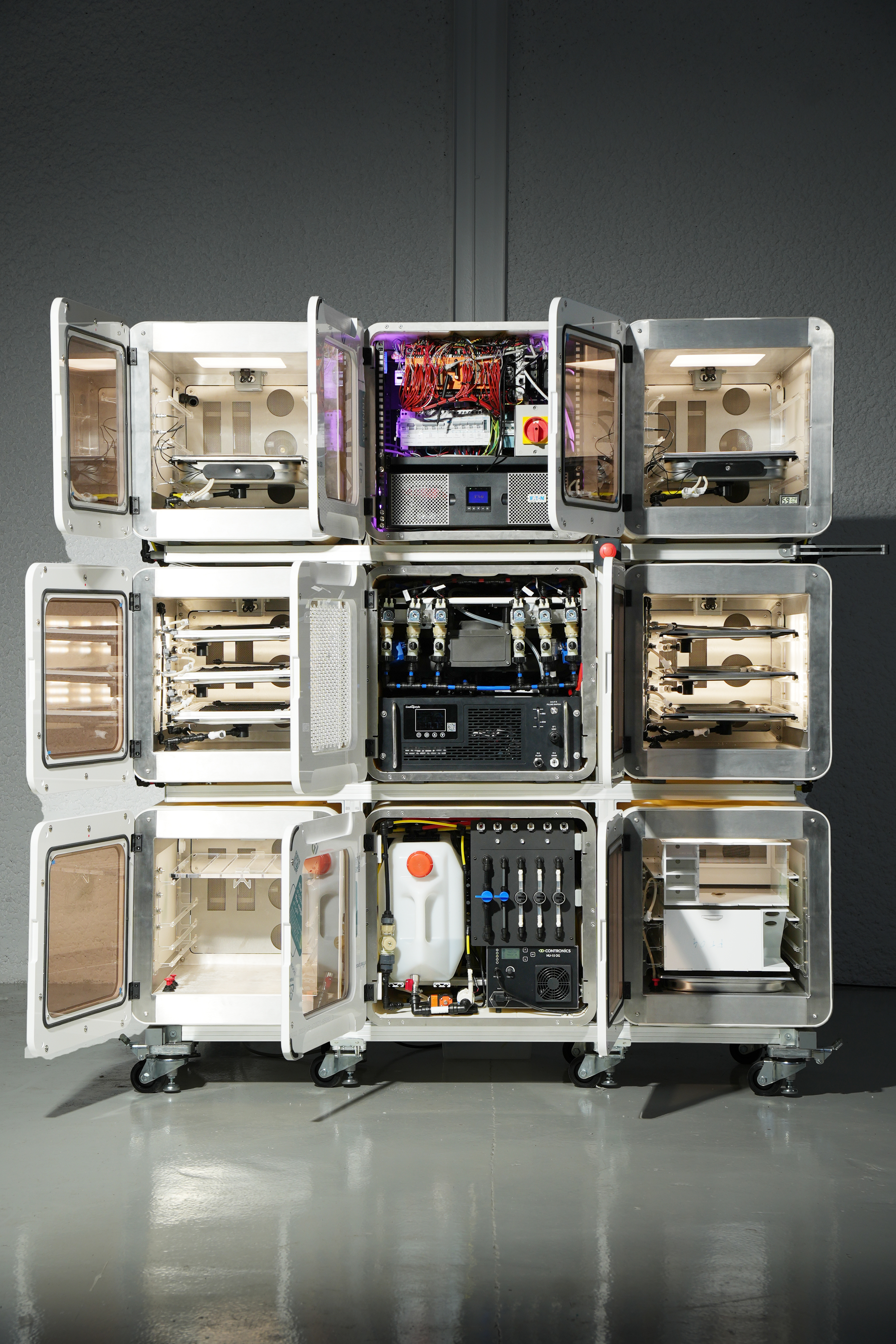
Interstellar’s NuCLEUS device, or Nutritional Closed-Loop Eco-Unit System, is a series of cubes that can fit on a space station or other small, off-Earth environment. It won the 2024 Deep Space Food Challenge, a NASA-Canadian Space Agency contest. Credit: Interstellar Lab Inc.
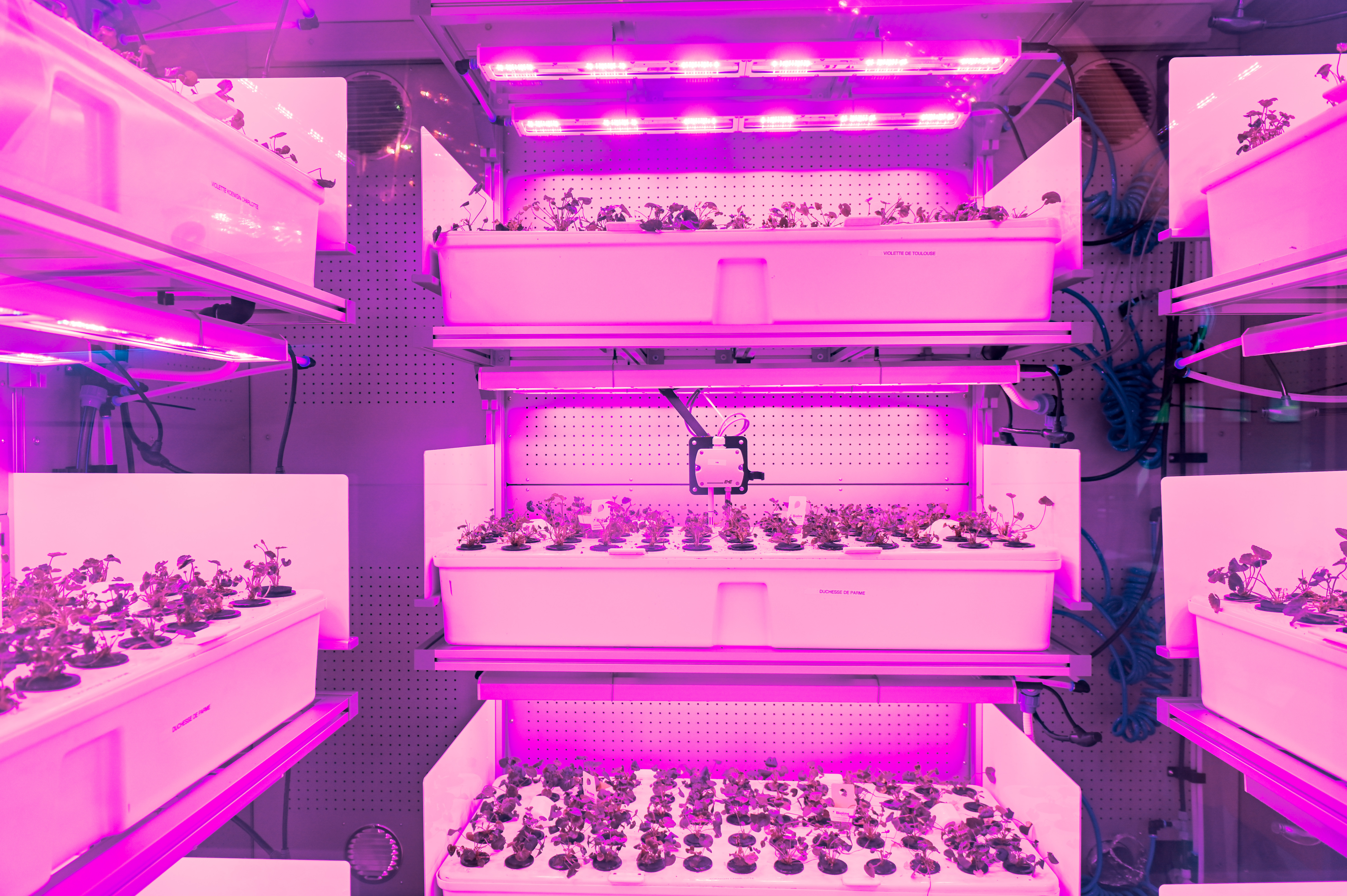
The NuCLEUS space-based growing system formed the basis of a second spinoff called Pleiades, a smaller, modular farming system Interstellar uses to conduct research on more precise growing strategies for companies on Earth. Credit: Interstellar Lab Inc.
Interstellar Lab has recently been growing flowers, like the rose-scented geranium pictured here, for a large perfumer. Credit: Interstellar Lab Inc.