

A Better Seat For the Seated
Subheadline
Experience meeting NASA requirements helped design innovative wheelchair cushion
Whether seated atop a rocket waiting to go to space or deskbound at work, sitting all day tends to not be good for the body. However, there are those who have no choice in the matter. According to the National Institutes of Health, people who need wheelchairs to move have a higher incidence of blood clots and deep vein thrombosis in the legs and lower body than others, due in part to pressure from wheelchair seats.
“We need to offload that pressure, but in a way that you don’t have to move.” said Tim Balz, founder and CEO of Kalogon Inc.
Kalogon manufactures specialized cushions designed to alleviate pressure. Balz became passionate about assistive technology in high school, where he started a nonprofit that would refurbish used wheelchairs and give them away to those who needed them. During college, he kept working on designs for a “smart” wheelchair, and soon after graduation, he accepted an offer to work at SpaceX.
SpaceX is one of the most prominent NASA contractors, especially in its role as part of the Commercial Crew Program. Balz worked at SpaceX’s facility near NASA’s Kennedy Space Center in Florida and helped to ensure the Dragon capsule met NASA’s requirements for commercial human spaceflight, which were originally set in 2005 and have been consistently updated since.
“There are human factors, and there are performance factors. These are all things that have to be factored into the design of a vehicle,” said David Francisco, technical fellow for human spaceflight standards at NASA’s Johnson Space Center in Houston. “How much strength does it take to open a door? How much lighting is required? How long does it take to egress the vehicle?”
At SpaceX, Balz shuffled through multiple teams, covering all the different engineering needs for sending a rocket full of people to space. At the same time, he was working on what would become Kalogon’s cushion. SpaceX had an open data policy, and while Balz was working on one project, he would
see how the company was approaching others, particularly when it came to meeting NASA’s requirements for the Commercial Crew Program, including spacesuits.
“The material the suits are made of has to be durable enough to hold the pressure but still maintain the flexibility to move. And whenever you talk about pressurizing something, you’re always looking at how it’s stitched,” said Francisco. “At the same time, you don’t want it to be so inflated that you can’t move your hands or manipulate controls.”
The spacesuits required by the Commercial Crew Program are only needed for “intravehicle” activity, meaning they’re only exposed to a vacuum in an emergency. At the same time, these suits still had to provide protection for several situations, presenting the suit designers with many challenges to meet NASA’s standards.
“I would go look up things and try to learn some of the creative techniques they were using at that point. Theoretically, we were trying to solve a lot of the problems that NASA was having with their spacesuits,” said Balz. “Through that, I learned a good deal about making soft goods, and a wheelchair cushion has a lot of soft goods.”
Not long after his departure from SpaceX in 2020, Balz founded Kalogon, based in Melbourne, Florida. Speaking with local customers about the issues they face being wheelchair-bound, Balz found that preventing sores and improving circulation was a much-needed benefit that a high-tech cushion could provide. Much like a spacesuit, which manages air pressure around an astronaut, Kalogon’s cushion works by managing air pressure around a user’s bottom. Inside the cushion, a half dozen air cells are inflated and deflated to constantly change where pressure is applied to the body. This pressure difference flexes blood vessels in the thighs and keeps blood flowing while the user is sedentary. Balz’s research into how the spacesuits were built, how they manage pressure, and how the suits perform when astronauts have a rough landing have all played a part in designing Kalogon’s technology.
Kalogon’s “smart cushions” can be found in both homes and hospitals. The company’s flagship product line is called Orbiter. And because it can quickly and easily change its shape, Balz says Orbiter offers flexibility that normal wheelchair cushions don’t provide.
“We sit very differently when we’re driving, versus when we’re typing, versus when we’re eating, versus when we’re relaxing. If you use a normal wheelchair cushion, you get to pick one posture and it has to be your posture for everything,” said Balz. “With our product, people can click a button on an app and have the cushion change shape, allowing them to go do activities that otherwise would have been difficult.
In addition to the Classic edition, there is also Orbiter Med, which is molded specifically for individual users with special needs, allowing it to be covered by Medicare as a necessary assistance device. And Booster is a smart pump that maintains or adjusts the pressure in wheelchair air cushions in conjunction with the Kalogon app. As of late 2024, the company has sold thousands of units across its product lineup.
While the primary market for the cushion is wheelchair users, Kalogon is looking to expand to a wider audience. The company has received multiple Phase II Small Business Innovation Research contracts from the Air Force for a product called Orbiter Ace, which adapts its tech for B-52 and E-4B aircrews and is exploring options with the wider commercial aviation industry. In the future, Balz sees airline pilots and long-haul truck drivers using Kalogon cushions to keep their blood flowing. While pressure from seating isn’t an issue for weightless astronauts, Kalogon is one more example of solutions for the many difficulties of space travel finding unexpected uses here on Earth.
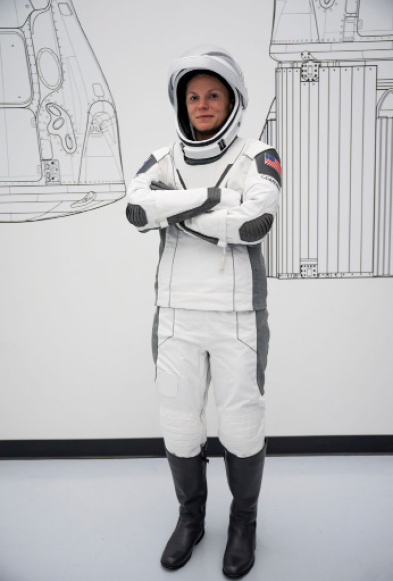
To fulfil NASA’s requirements for Commercial Crew missions to the International Space Station, SpaceX had to design spacesuits that would be able to go to space and hold air in case the capsule lost pressure. These spacesuit designs would go on to inform the development of Kalogon’s smart cushion. Credit: NASA
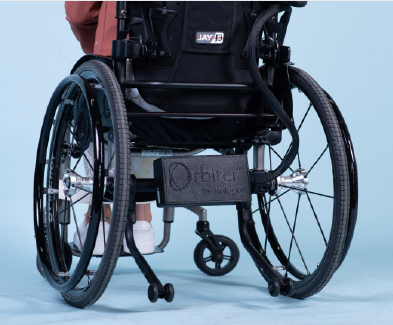
Orbiter is designed to fit any wheelchair and is easy to install and control. Credit: Kalogon Inc.
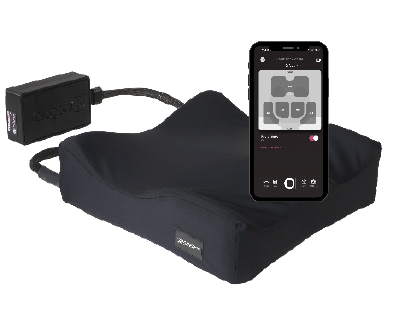
The Orbiter Med is one of Kalogon’s best-selling products. Its design can be molded to an individual’s exact measurements, and its companion app lets users adjust the seat for various activities. Credit: Kalogon Inc.
The Orbiter wheelchair seat was designed to help those in wheelchairs be more active. The blue cushion uses air bladders to improve blood flow and reduce sores. Credit: Kalogon Inc.